
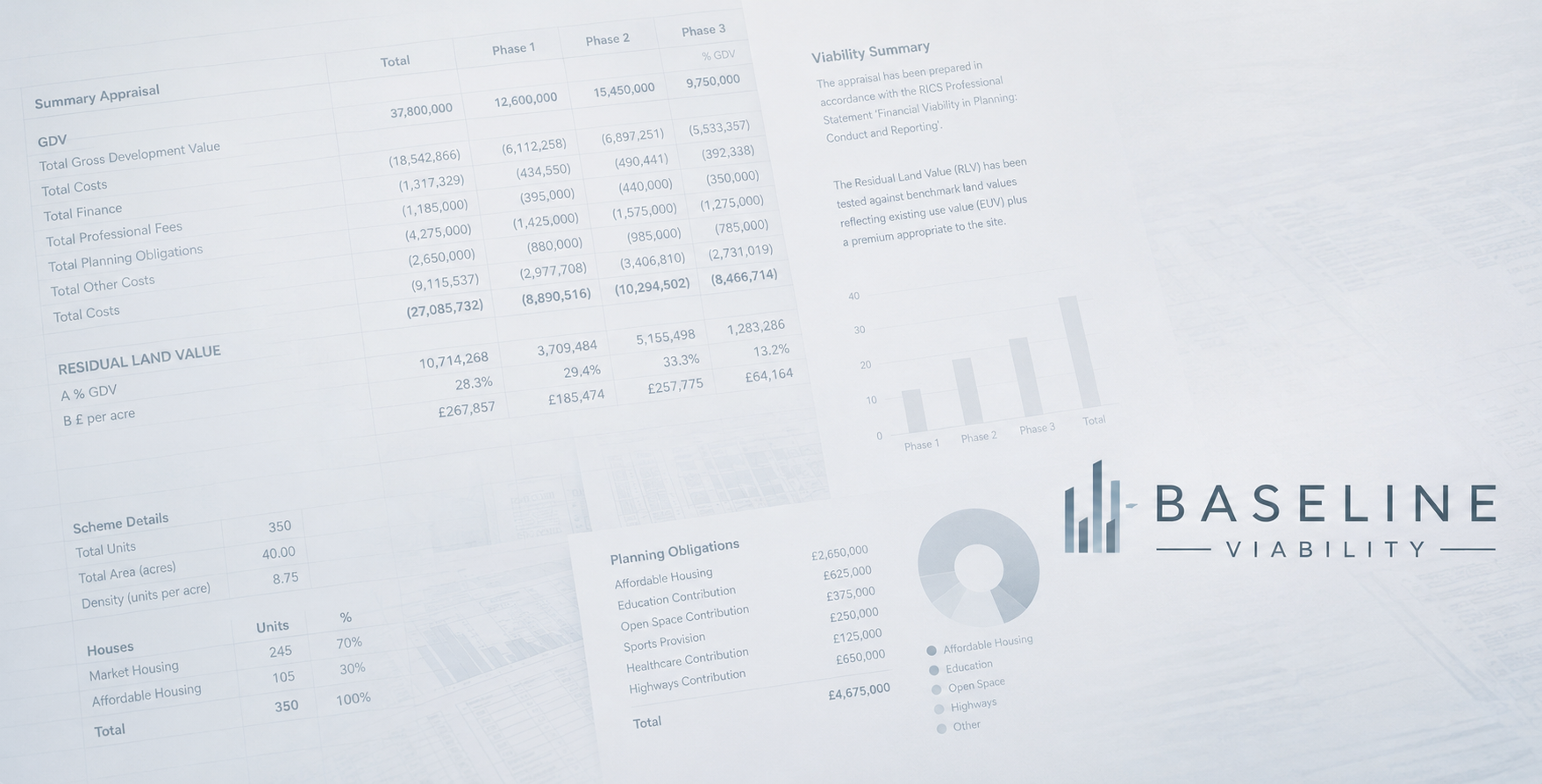
Baseline Viability
Developer-led financial viability assessments to support planning and unlock value.
Landarm supports developers, landowners, local authorities and review consultants with financial viability advice that is commercially realistic, clearly evidenced and capable of supporting deliverable planning outcomes.
The focus is not simply on preparing a financial viability appraisal, but on presenting a credible position that can withstand scrutiny, reduce unnecessary delay and help schemes move forward in practice.
Financial Viability Assessments (FVAs) are increasingly required to support Section 106 negotiations, affordable housing reviews and wider planning discussions where development viability is under pressure.
The Challenge
Poor viability advice can delay schemes, distort negotiations and undermine deliverability.
Many FVAs rely on standardised assumptions that do not reflect how schemes are actually delivered. Build costs are simplified, abnormal costs overlooked, and comparable evidence applied without sufficient nuance.
In practice, development is rarely straightforward. Site constraints, infrastructure requirements, market conditions, funding costs and programme pressures all influence viability and can materially affect whether a scheme is capable of being delivered.
At the same time, the planning process is rarely aligned with statutory timeframes. Delays in preparing, reviewing and challenging viability positions can result in extended negotiations, missed windows, and schemes losing momentum.
Poorly evidenced or unrealistic financial viability submissions can create unnecessary friction between developers, planning officers and review consultants, often leading to repeated revisions and prolonged debate.
In practice, time is risk — and FVA’s that lack commercial realism or clarity can add weeks or months to the process, with genuine financial consequences.
A planning permission that cannot realistically be implemented benefits nobody. Robust, evidence-based viability work should support not only decision-making, but the practical delivery of consented schemes.
Developer-led Approach
Landarm approaches financial viability from a developer’s perspective — recognising that both accuracy and timing are critical.
FVA’s are built around how projects are actually delivered, reflecting real construction costs, site-specific constraints, sales evidence and funding considerations.
The focus is not simply on policy compliance, but on producing viability positions that are commercially realistic, robustly evidenced and capable of supporting delivery in practice.
Just as importantly, the process is structured to move efficiently. Clear, well-supported positions reduce the scope for prolonged debate, helping to avoid unnecessary delay in negotiations with planning officers, local authorities and review consultants.
This practical understanding of development, funding, programme pressures and delivery risk helps ensure viability work reflects the realities of bringing schemes forward — not simply theoretical assumptions.
Early viability input can also help developers assess schemes at acquisition or option stage, providing a clearer understanding of potential planning obligations, delivery constraints and commercial risk before significant time and cost are committed.
Equally, where local authorities or review consultants require financial viability reviews, timely and clearly structured reporting can help support efficient decision-making and reduce unnecessary delay within the planning process.
The result is a robust, evidence-based position that can be clearly articulated, carefully scrutinised and realistically implemented once planning permission is granted.
What’s Included
Effective viability work requires more than an appraisal model — it requires commercially grounded judgement.
Landarm’s viability work is tailored to the specific requirements of each scheme, whether supporting land acquisition, planning applications, Section 106 negotiations or independent viability review.
Services typically include:
Financial Viability Appraisals and supporting reports
Review of build costs, including abnormal and site-specific items
Sales value analysis using relevant comparable evidence
Section 106 and affordable housing viability support
Viability reviews for planning applications and negotiations
Support through discussions with planning officers and review consultants
Input on review mechanisms and viability exposure
Early-stage viability input for acquisitions, options and development strategy
Independent viability reviews for local authorities and consultants
Commercially Grounded Viability Advice
Robust viability work should do more than support a planning submission — it should create schemes that can realistically be delivered in a challenging economic climate.
Landarm’s approach combines commercial awareness, practical delivery experience and evidence-based reporting to support developers, landowners, local authorities and review consultants through increasingly complex viability discussions.
Whether supporting early-stage acquisitions, live planning applications or independent viability review, the focus remains the same: producing financial viability assessments that are commercially realistic, clearly evidenced and capable of supporting delivery in practice.
To discuss your project, please get in touch here.
Frequently Asked Questions
-
A Financial Viability Assessment (FVA) is used to assess whether a proposed development can viably support planning policy requirements such as affordable housing, Section 106 contributions and abnormal development costs, whilst still remaining commercially deliverable.
-
A Section 106 viability review may be required where planning policy obligations place pressure on scheme viability, particularly in changing market conditions or where abnormal costs, build cost inflation or reduced sales values affect deliverability. Local Authorities will often require viability evidence to support affordable housing reviews, policy compliance discussions or planning negotiations.
-
Development viability appraisals can differ significantly between consultants depending on the assumptions adopted around sales values, build costs, finance, programme, abnormal costs and developer return. A developer-led approach can often provide additional commercial context and delivery insight beyond standardised appraisal assumptions alone.
-
Affordable housing requirements can often be reduced or eliminated completely, where a Financial Viability Assessment demonstrates that planning policy obligations would otherwise make a development undeliverable. Local Authorities will typically require robust viability evidence before considering amendments to affordable housing or Section 106 obligations.
-
A Financial Viability Assessment will typically consider existing use value along with development values, build costs, abnormal costs, finance, programme, planning obligations and developer return. Supporting evidence may include comparable sales data, cost information, site constraints and broader market commentary relevant to the proposed development.
-
Developer-led viability assessments can provide additional commercial and operational insight into how schemes are actually delivered in practice. This can include a more detailed understanding of programme risk, procurement, abnormal costs, sales strategy and wider market pressures affecting development viability.